

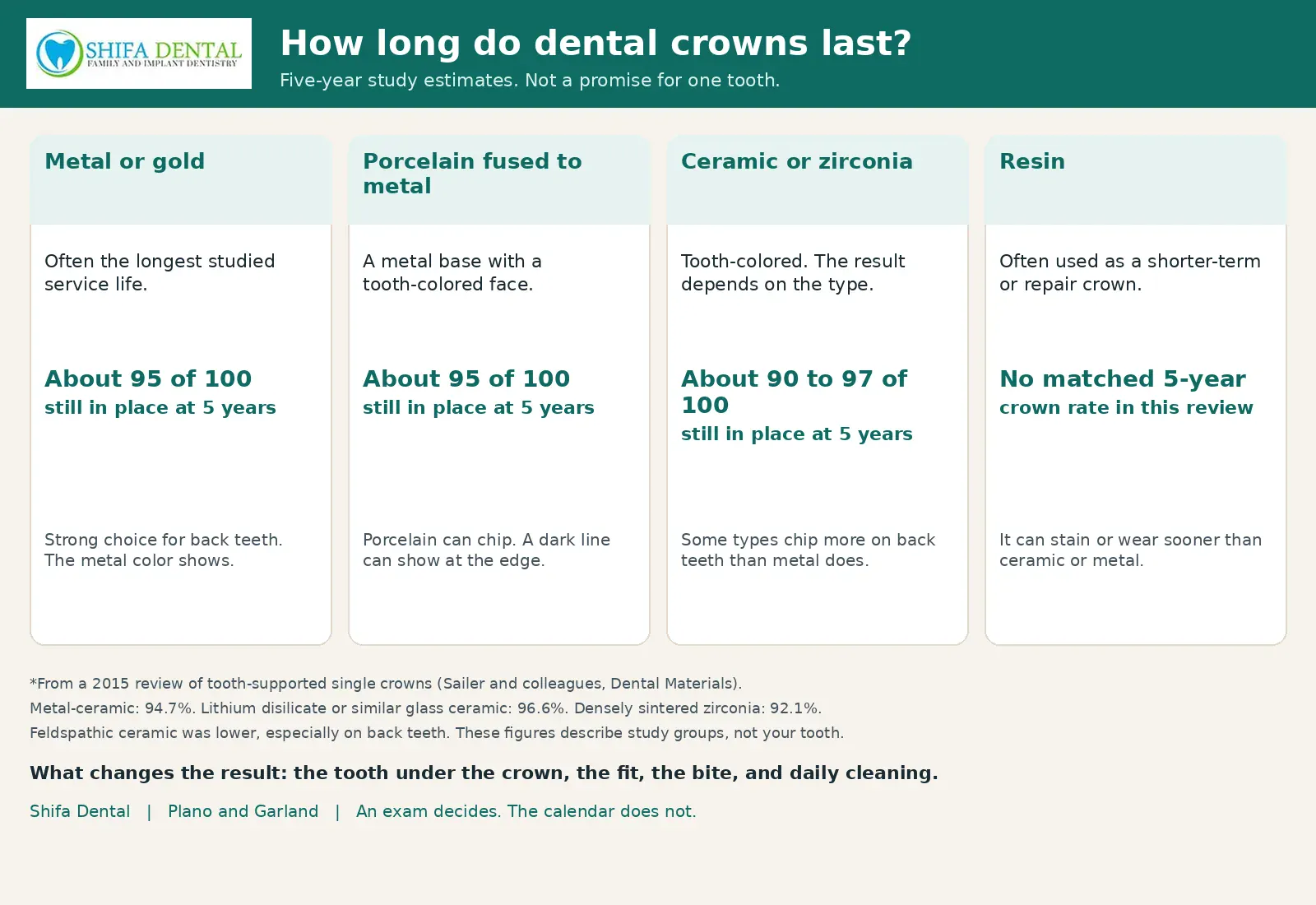
How long do dental crowns last? In a 2015 review of tooth-supported single crowns, about 95 of 100 metal-ceramic crowns were still in place after 5 years. Stronger glass ceramics were similar, at about 97 of 100. Densely sintered zirconia was about 92 of 100. Those are study estimates, not a promise for your tooth. The tooth underneath, the fit, your bite, and daily cleaning all change the result. An exam, not the calendar, shows whether a crown is stable.
By Dr. Muhibunnisa Shaik, dentist at Shifa Dental in Plano and Garland
Shifa Dental provides family and restorative care at two offices. The Plano office is at 5509 Pleasant Valley Dr #90A, Plano, TX 75023. The Garland office is at 1918 N Plano Rd, Garland, TX 75042. Hours can differ by office and by day, so confirm the day’s schedule when you book. The practice accepts most insurance plans, and you still need to verify your own policy.
Key takeaways
- A 2015 review estimated that about 95 of 100 metal-ceramic crowns were still in place at 5 years.
- Lithium disilicate and similar glass ceramics were about 97 of 100. Densely sintered zirconia was about 92 of 100.
- Metal or gold, porcelain fused to metal, ceramic or zirconia, and resin do not share one lifespan.
- The natural tooth at the crown edge can still decay. The crown material itself does not.
- Age alone is not a reason to replace a crown. Looseness, a crack, a bite change, or new pain is a reason to call.
How long do dental crowns last, and why does it vary?
A crown is a custom cap that covers a damaged tooth so you can chew and, when the material allows, keep a natural look. It works with the tooth under it, the gums, and the teeth it bites against. Two crowns of the same material can have very different stories. One tooth may have more healthy structure left. One person may clench. One edge may be harder to keep clean.
That is why a single year count cannot predict every restoration. The 2015 review by Sailer and colleagues in Dental Materials pooled clinical studies with at least 3 years of follow-up. It estimated 5-year survival, meaning the crown was still in place, not that every crown looked or felt perfect. The American Dental Association’s overview of indirect materials also separates metal alloys, ceramics, metal-ceramics, and resin composites by strength, appearance, and where they are used. Neither source is a quote for your tooth.
How do metal, porcelain, ceramic, and resin crowns compare?
Use this table to compare the four common groups. The 5-year figures come from the Sailer review of tooth-supported single crowns. They describe groups of patients in published studies. They are not Shifa Dental fees, guarantees, or a prediction for one crown.
| Material | What patients usually notice | 5-year study estimate | Trade-off to ask about |
|---|---|---|---|
| Metal or gold | Very strong. The color is not tooth-colored. | Metal-ceramic crowns: about 94.7 of 100 still in place. Full-metal crowns were long valued for durability. This review’s matched figure is the metal-ceramic group. | Best discussed for back teeth where strength matters more than color. |
| Porcelain fused to metal | A metal base with a tooth-colored porcelain face. | About 94.7 of 100 metal-ceramic crowns were still in place at 5 years (95% CI about 94.1 to 96.9). | Porcelain can chip. A dark edge can show if the gum recedes. |
| Ceramic or zirconia | Tooth-colored. Strength depends on the ceramic type. | Lithium disilicate or similar reinforced glass ceramic: about 96.6 of 100. Densely sintered zirconia: about 92.1 of 100. Feldspathic ceramic was lower, especially on back teeth. | Some ceramics chip or fracture more in the back of the mouth. Zirconia in that review had more veneer chipping than metal-ceramic crowns. |
| Resin | Tooth-colored and often used when a shorter-term or repairable crown is appropriate. | The Sailer review did not publish a matched 5-year survival rate for resin crowns. Do not borrow another material’s number. | Resin can wear, stain, or chip sooner than metal or ceramic. The ADA notes wear and discoloration as disadvantages. |
How long do metal or gold crowns last?
Metal and gold alloys have a long record of strength. The ADA describes high-noble and noble alloys as durable and hard, with poor tooth color, and lists crowns among their uses. In the Sailer review, the closely reported metal-based group is metal-ceramic: an estimated 94.7% were still in place at 5 years. That is about 95 of 100 crowns, in study groups, not a personal warranty.
A full-metal crown can be a practical choice on a back tooth that takes a heavy bite, because the metal color is less visible there. It is a poor match when you want the crown to disappear into a front smile. Gold content, alloy type, and whether any porcelain covers the metal all change the conversation. Ask which material is planned for your tooth and why.
How long do porcelain-fused-to-metal crowns last?
Porcelain fused to metal, often called a metal-ceramic crown, puts a tooth-colored face on a metal base. The same 2015 review estimated that 94.7% of these single crowns were still in place after 5 years. Survival here means the crown had not been lost. It does not mean the porcelain never chipped.
Chipping is the trade-off patients should expect to discuss. The porcelain layer can fracture while the metal base stays put. If the gumline recedes, a gray edge can show. That is a cosmetic finding, not automatic proof that the crown has failed. Your dentist can tell you whether the edge is stable or needs attention.
How long do zirconia crowns last?
Zirconia is a strong ceramic with a white color. In the Sailer review, densely sintered zirconia had an estimated 5-year survival of 92.1% (95% CI about 82.8 to 95.6). The range is wide, so that figure is not a precise forecast. A related alumina group in the same review was about 96%.
The same review found that zirconia crowns were more often lost because the veneering ceramic fractured, and they had more loss of retention than metal-ceramic crowns. Feldspathic and silica-based ceramics had lower survival, and they did worse on back teeth. Newer monolithic zirconia, made as one solid piece, is not the same product as an older veneered zirconia crown. Ask which form is planned. Do not treat a 15- or 20-year slogan as a measured result from this review.
How long do ceramic crowns last?
Ceramic is a family, not one material. Reinforced glass ceramics, including lithium disilicate, had an estimated 5-year survival of 96.6% in the Sailer review (95% CI about 94.9 to 96.7). That is about 97 of 100 still in place at 5 years in the pooled studies. Glass-infiltrated alumina was about 94.6%.
Weaker feldspathic porcelain was the outlier. The review said it should be limited toward the front of the mouth, where biting force is lower. A front tooth and a back molar do not ask the same thing of a ceramic. If appearance is the priority, say so. If the tooth grinds against a heavy bite, ask whether a stronger ceramic or a metal base is the better match.
How long do resin crowns last?
Resin, or composite, crowns are tooth-colored and can be repaired more easily than many ceramics. The ADA lists wear and discoloration as disadvantages, and high-stress areas as a poor fit. The Sailer single-crown review did not give resin its own 5-year survival figure. A separate review of back-tooth resin composites found similar longevity for direct and indirect techniques. That evidence was rated very low certainty, and it was not limited to full crowns.
Because of that, this article does not assign resin a year count. If a resin crown is suggested as a provisional or a repair, ask how long the dentist expects that role to last and what would prompt a switch to ceramic or metal. Do not apply the 90-to-97 ceramic figures to resin.
What changes how long your crown lasts?
Material is only one part of the story. The crown and the tooth succeed or fail together.
The tooth underneath
The natural tooth has to hold the crown. Earlier decay, a large fracture, or a root canal can leave less structure. Decay can still start on the natural tooth at the crown’s edge, because the crown material itself does not decay. Food catching in one spot, or a new rough edge, is worth mentioning. Neither sign proves decay on its own.
Fit and the crown edge
A crown should meet the tooth in a smooth, cleanable line. You often cannot judge that line in a mirror. Tell the office if floss shreds in one place, if food packs there, or if the edge feels different to your tongue. Do not file or pry at the edge yourself.
Bite, habits, and cleaning
Clenching, grinding, an uneven bite, and chewing ice or hard candy add stress. Worn teeth or jaw soreness on waking is useful information, not a diagnosis. Brush twice a day with fluoride toothpaste and clean between the teeth daily. The American Dental Association’s patient resources cover that general routine. If a night guard is being considered, this overview of what happens during a night guard procedure can help you prepare questions. A guard is appropriate only after an exam.
Keep cleanings at the interval recommended for you. For local context, see dental cleanings in Plano and Garland.
Which changes should prompt you to call?
Call the office for advice if a crown feels loose, shifts, chips, cracks, or comes off. Also call for a changed bite, a sharp edge, new sensitivity, pain when chewing, swelling, or food that keeps catching beside the crown. These signs have more than one cause. They do not automatically mean the crown must be replaced.
If the crown comes off, keep it safe, avoid chewing on that side, and do not use household glue. If pain or swelling is severe or getting worse, seek prompt dental advice rather than waiting to see if it settles. Note when it started, what triggers it, and whether the crown moves. If another office made the crown, share the approximate date and material if you know them.
Does an old crown always need replacement?
No. Age by itself does not show that a crown has failed. If the exam finds a stable crown and a healthy edge, monitoring can be the right plan. If the exam finds a fracture, a loose fit, or decay at the margin, the dentist can discuss repair or replacement.
A replacement visit looks at the remaining tooth, the material, the bite, and what treatment would involve. For what can change an estimate, read factors that can affect dental crown cost. That article is not a personal quote.
The live Shifa Dental savings page lists a porcelain crown at a regular price of $1,584 and a Shifa Smiles Plan member price of $849. That is one listed porcelain fee on that page, not a guarantee and not the price of every material. The membership discount does not stack with insurance or coupons, and it excludes specialist-rendered care and lab fees. Confirm the current listing on the savings plan page before you rely on it. CareCredit, Cherry, and in-house plans are for qualified applicants and depend on treatment. See the financing page for partner names. Coverage rules are separate: what to ask about dental insurance for crowns and how to verify your dental benefits.
How should you choose Plano or Garland for a crown visit?
Pick the office that is easier for you to reach. Both locations offer crown consultations. Plano patients can start with the dental crowns page for Plano. Garland patients can start with the dental crowns page for Garland. If you are comparing a crown with a filling, this overview of filling types and trade-offs can help you frame questions. It cannot choose the treatment.
The shared scheduler asks you to choose Shifa Dental in Plano or Shifa Dental in Garland before a time appears. Choose the office you want. The address shown after that choice should match the office page: 5509 Pleasant Valley Dr #90A in Plano, or 1918 N Plano Rd in Garland. Published phone numbers differ across pages, so use the number shown for the office you select, or call from the location page, and confirm that day’s hours.
- Decide whether Plano or Garland is the easier office for you.
- Open the scheduler and choose that office by name.
- Check that the address matches the office you wanted.
- Bring questions about material, the tooth under the crown, and any chip, looseness, or pain.
- Ask what the exam showed before you agree to a replacement.
Schedule at the Plano or Garland office
Frequently asked questions
How long do dental crowns last on average?
There is no single lifespan. In a 2015 review, about 95 of 100 metal-ceramic crowns and about 97 of 100 lithium disilicate-type glass ceramic crowns were still in place at 5 years. Densely sintered zirconia was about 92 of 100. Your tooth, bite, and care can move the result either way.
How long do zirconia crowns last?
The Sailer review estimated that about 92 of 100 densely sintered zirconia single crowns were still in place at 5 years, with a wide confidence range. Veneered zirconia had more chipping than metal-ceramic crowns in that review. Newer one-piece zirconia is a different design, so ask which type is planned.
Can a crowned tooth still get a cavity?
Yes. The crown material does not decay, but the natural tooth near its edge can. Brush along the gumline, clean between the teeth, and keep the visit interval your dentist recommends.
Should I replace an old crown if it does not hurt?
Not only because it is old. An exam can show whether the crown and its edge are stable. Call if it feels loose, looks cracked, or the bite feels different, even when the pain is mild.
What should I do if my crown feels loose?
Call the office and avoid chewing on that side. Do not use household glue. If the crown comes off, keep it and describe when it happened. Choose Plano or Garland when you schedule so the visit is booked at the office you want.