


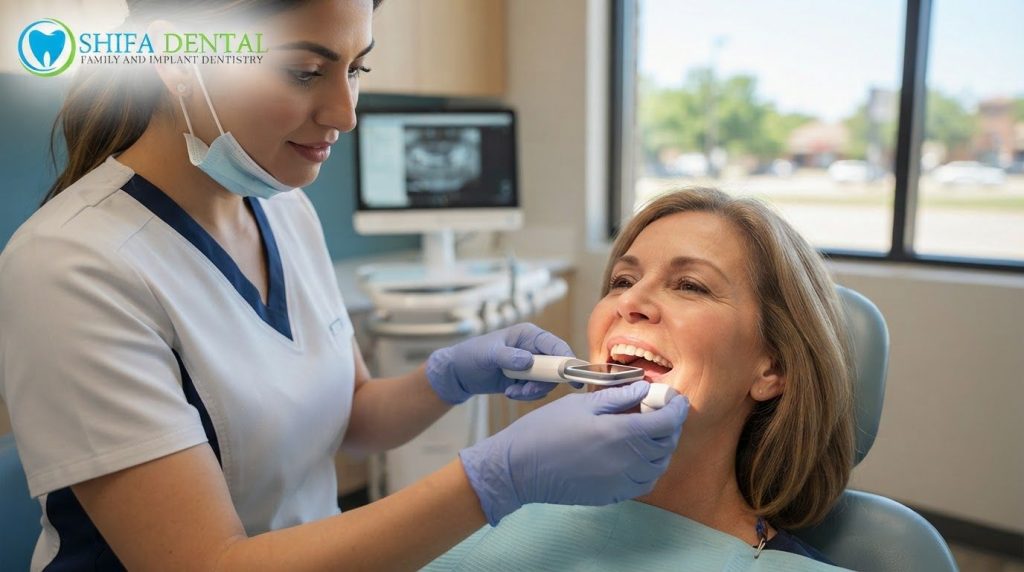
Dental X-rays in Plano, TX are a critical diagnostic tool that help your dentist detect cavities, bone loss, infections, and other oral health issues invisible to the naked eye. Modern digital dental X-rays in Plano use 80–90% less radiation than traditional film, making them safer than ever. Whether you’re a new patient at Shifa Dental or returning for a routine checkup, understanding what dental X-rays are, why your dentist recommends them, and how they keep you safe is essential to making informed decisions about your oral health care in North Dallas.
What Are Dental X-Rays in Plano and Why Does Your Dentist Need Them?
Dental X-rays, also called radiographs, are images of your teeth and jawbone created using a small amount of radiation. Unlike a visual exam in the chair, dental X-rays in Plano let your dentist see beneath the gum line and inside the tooth structure—areas where decay, bone loss, infections, and other problems hide. Think of them as a window into the parts of your mouth that matter most for long-term health.
Your dentist uses dental X-rays in Plano to diagnose and monitor:
- Cavities — especially between teeth, where a mirror and explorer cannot reach
- Decay beneath existing fillings — a common source of secondary cavities
- Bone loss — a sign of gum disease or periodontal problems
- Abscesses and infections — pus pockets at the tooth root or between gum and tooth
- Impacted or unerupted teeth — wisdom teeth, supernumerary teeth, or teeth stuck in bone
- Cysts, tumors, and other lesions — including some oral cancers affecting the jaw
- Healing after procedures — root canals, bone grafts, extractions, or implants
- Treatment planning — for implants, braces, dentures, or orthodontic alignment
At Shifa Dental in Plano and Garland, we recommend dental X-rays based on your individual risk factors and clinical presentation—not as a routine “one-size-fits-all” protocol. This patient-centered approach aligns with the American Dental Association’s evidence-based guidelines and ensures you receive the imaging you truly need.
How Do Modern Dental X-Rays in Plano Work?
Dental X-rays use ionizing radiation—the same physics behind medical X-rays elsewhere in your body—to pass through soft tissues and bone, creating an image on a sensor or film. The radiation beam is directed from the X-ray head, passes through your mouth, and is captured by a digital sensor (or, in older offices, photographic film). The image is then displayed on a computer screen for your dentist to analyze.
The key innovation in modern dental X-rays is digital technology. Digital sensors are far more sensitive than film, so they require significantly less radiation exposure—typically 80–90% less than traditional radiographs. This means dental X-rays in Plano today are faster, clearer, and safer than they were even a decade ago.
Intraoral vs. Extraoral Dental X-Rays in Plano
Dental X-rays fall into two broad categories based on where the sensor is positioned:
Intraoral X-rays (sensor inside your mouth):
- Bitewing — Shows the upper and lower back teeth in one image; excellent for detecting cavities between teeth and below the gumline
- Periapical (PA) — Captures one or two teeth from crown to root tip; used to diagnose gum disease, bone loss, and infections
- Occlusal — Shows the roof of your mouth or floor of your mouth; helps find impacted teeth or jaw fractures
Extraoral X-rays (sensor outside your mouth):
- Panoramic (Pano) — Wide-angle view of your entire mouth, both jaws, teeth, sinuses, and bone; used for comprehensive assessment and wisdom tooth evaluation
- Cephalometric — Side-view of your head; primarily used in orthodontic planning (Invisalign, braces)
- Cone Beam CT (CBCT) — 3D imaging of teeth, jaws, nerves, and sinuses; reserved for complex implant planning, bone grafting, or oral surgery
At Shifa Dental in Plano, we select the appropriate type based on your clinical needs. A routine checkup might require only bitewings; implant planning might call for a CBCT; and a new-patient exam often includes a panoramic X-ray to establish a baseline.
Radiation Safety: Are Dental X-Rays in Plano Safe?
Patient anxiety about radiation is one of the most common concerns we hear at Shifa Dental. The good news: dental X-rays in Plano expose you to extraordinarily low levels of radiation—far less than many people assume.
How Much Radiation Do Dental X-Rays in Plano Expose You To?
A full series of dental X-rays (typically 14–18 intraoral films plus a panoramic image) exposes you to approximately the same amount of radiation as:
- One to three hours of natural background radiation from the sun and earth
- One cross-country airplane flight (due to cosmic radiation at altitude)
- Living near granite or ceramic tile buildings for several days
According to the American Dental Association, dental imaging accounts for less than 1% of total annual medical imaging radiation exposure in the United States. By comparison, a single CT scan of the chest delivers far more radiation than an entire year of dental X-rays.
Digital dental X-rays in Plano reduce exposure even further. Because digital sensors are so sensitive, your dentist can achieve diagnostic-quality images with half the radiation dose of film-based radiographs.
The ALARA Principle: Minimizing Exposure
Shifa Dental follows the ALARA principle (As Low as Reasonably Achievable), developed by the International Commission on Radiologic Protection. This means:
- Justification: We only order dental X-rays in Plano when clinically necessary—not as routine screening for every patient at every visit.
- Optimization: We use the fastest image receptors (digital sensors), proper positioning, and rectangular collimation (narrowing the X-ray beam to the exact area of interest).
- Dose Limitation: We keep radiation doses well below regulatory limits and encourage patients to bring previous X-rays from other dentists to avoid duplication.
What Changed in 2024: Lead Aprons and Thyroid Collars
In 2024, the American Dental Association released updated guidance that surprised many patients: lead aprons and thyroid collars are no longer recommended for routine dental X-rays in Plano or anywhere else. Why? Because these shields can actually block part of the primary X-ray beam, forcing your dentist to retake the image—resulting in more total radiation exposure, not less.
Instead, modern radiation protection focuses on:
- Rectangular collimation — restricting the beam to only the area being imaged
- Proper patient positioning — ensuring the best image on the first attempt
- Digital imaging — using technology that requires minimal dose
- Clinical judgment — ordering X-rays only when the diagnostic benefit outweighs the small radiation risk
At Shifa Dental in Plano, we follow this evidence-based approach and can explain the reasoning to any patient who has concerns.
How Often Should You Get Dental X-Rays in Plano?
| Patient Category | Recommended Frequency | Reason |
|---|---|---|
| Healthy adults, no cavities or gum disease | Every 6–18 months | Baseline screening; early detection of new decay |
| Adults with history of cavities or gum disease | Every 6–12 months | Higher risk; more frequent monitoring needed |
| Children (primary and mixed dentition) | Every 6–12 months | Teeth erupting and changing; higher cavity risk |
| Patients with active gum disease (periodontal) | Every 6 months or as needed | Monitoring bone loss and treatment response |
| New patients to Shifa Dental | Baseline series (panoramic + bitewings) | Establishing baseline health status and treatment needs |
| Implant or orthodontic planning | As needed (may include CBCT) | Detailed 3D imaging for surgical or orthodontic planning |
These guidelines follow the American Dental Association and FDA recommendations updated in 2026. Your dentist at Shifa Dental in Plano will assess your individual risk factors and clinical presentation to determine the right schedule for you. There is no “one-size-fits-all” interval.
Dental X-Rays in Plano for Special Populations
Are Dental X-Rays Safe for Children?
Yes. Children are actually more prone to cavities than adults, so regular dental X-rays in Plano are often recommended more frequently for kids—typically every 6–12 months. Modern digital X-rays are safe for children because:
- Digital sensors require minimal radiation dose
- The American Academy of Pediatric Dentistry endorses dental X-rays as part of preventive care
- Early cavity detection prevents more invasive treatment later
- The benefit of finding and treating decay far outweighs the minimal radiation risk
At Shifa Dental in Plano, we’re experienced in pediatric dentistry and use child-sized positioning and exposure times to further minimize radiation. We also explain the process to children so they feel comfortable and secure.
Dental X-Rays During Pregnancy
Dental X-rays in Plano are considered safe during pregnancy. Both the American Dental Association and the American Pregnancy Association agree that the radiation exposure to a fetus is minimal—far less than the risk of untreated dental infection or emergency extractions during pregnancy.
Most dentists prefer to avoid elective X-rays during the first trimester and focus on urgent diagnostic imaging if needed. If you’re pregnant or planning to become pregnant, inform your dentist at Shifa Dental so we can discuss which dental X-rays are appropriate for your situation.
What to Expect During a Dental X-Ray Appointment in Plano
Understanding the process removes anxiety. Here’s what happens when you come in for dental X-rays in Plano:
- Check-in: You’ll complete a brief health history, including any medications, allergies, or pregnancy status.
- Clinical exam: Your dentist or hygienist performs a visual exam to determine which X-rays are needed.
- Positioning: For intraoral X-rays, you’ll bite gently on a small sensor holder. For panoramic or CBCT, you’ll stand or sit still while the machine rotates around your head.
- Exposure: The technician steps behind a protective barrier and activates the X-ray. You’ll hear a brief beep; the actual exposure lasts less than a second.
- Review: Your dentist reviews the images immediately on a computer screen and discusses findings with you.
- Treatment planning: If issues are detected (cavities, bone loss, impacted teeth), your dentist will discuss next steps and options.
The entire process takes only a few minutes. You won’t feel pain or discomfort; the only sensation is the slight pressure of the sensor in your mouth during intraoral X-rays.
Why Shifa Dental in Plano Uses Digital X-Rays
At Shifa Dental in Plano, we’ve invested in state-of-the-art digital radiography systems because they benefit you in multiple ways:
- Lower radiation: 80–90% less than film, so you’re exposed to minimal ionizing radiation.
- Instant images: No waiting for film development; your dentist reviews images immediately and discusses findings on the same day.
- Enhanced clarity: Digital images can be magnified and adjusted for contrast, helping your dentist catch subtle decay or bone loss.
- Easy comparison: Digital files are stored securely and can be compared year-to-year to track changes in your oral health.
- Eco-friendly: No chemical processing or film waste.
- Patient education: Your dentist can show you the images on a screen, explaining findings in real time and building confidence in treatment recommendations.
Our commitment to modern technology, combined with our adherence to ADA guidelines, means you receive the highest standard of diagnostic care with minimal radiation exposure.
Cost and Insurance Coverage for Dental X-Rays in Plano
Most dental insurance plans in Plano and North Dallas cover routine diagnostic X-rays as part of preventive care. Typically:
- Bitewing X-rays (routine cavity screening) are often covered at 100% with no copay if done as part of a preventive visit.
- Panoramic X-rays (new-patient baseline or comprehensive exam) are usually covered at 100% or a small copay.
- Periapical X-rays (diagnostic, related to a specific tooth concern) are typically covered at 80–100%, depending on your plan.
- CBCT scans (3D imaging for implants or complex cases) may have higher copays or require prior authorization, as they’re considered specialized diagnostic imaging.
At Shifa Dental in Plano, we accept most major insurance plans, including children’s Medicaid and CHIP. We also offer:
- Shifa Dental Saving Plan: For uninsured patients, a membership plan with discounted rates on all services, including X-rays.
- 0% interest financing: CareCredit and other payment plans for larger diagnostic or treatment expenses.
- No hidden fees: We quote all costs upfront, including X-ray fees, so you know exactly what to expect.
If you’re uninsured or have questions about your coverage, call Shifa Dental in Plano at (469) 507-3786 and ask about your specific plan or our Saving Plan options.
When Should You Call Your Dentist About Dental X-Rays?
Frequently Asked Questions About Dental X-Rays in Plano
How much radiation does a single dental X-ray expose me to?
A single bitewing X-ray exposes you to approximately 0.005 millisieverts (mSv)—roughly the same as one hour of natural background radiation from the sun and earth. A full series of dental X-rays in Plano (14–18 intraoral films plus a panoramic) totals about 0.035 mSv, which is less radiation than a cross-country flight. For perspective, the annual occupational limit for radiation workers is 50 mSv, so dental X-rays represent a tiny fraction of that threshold.
Can I refuse dental X-rays?
Yes, you have the right to decline dental X-rays in Plano. However, many dentists won’t move forward with treatment planning or diagnosis without them, as they provide critical information invisible to the naked eye. If you have concerns, discuss them with your dentist at Shifa Dental. We’re happy to explain why we recommend specific X-rays and address any fears about radiation or discomfort.
Do dental X-rays show cancer?
Dental X-rays in Plano can reveal some types of oral cancer—particularly those affecting or spreading to the jaw—but they don’t catch all forms of mouth cancer. That’s why regular oral cancer screenings (a visual and tactile exam by your dentist) are equally important. At Shifa Dental, we perform thorough oral cancer screenings as part of every comprehensive exam.
How often should a child get dental X-rays?
Children typically need dental X-rays in Plano every 6–12 months, depending on their cavity risk, age, and whether they’re losing baby teeth and growing new ones. The American Academy of Pediatric Dentistry endorses this frequency because early cavity detection in children prevents pain, infection, and the need for more invasive treatment. Shifa Dental’s pediatric team uses child-friendly techniques and minimal-dose digital imaging to keep kids comfortable and safe.
Are digital dental X-rays in Plano really safer than film?
Yes. Digital sensors are 80–90% more sensitive than traditional film, so they require significantly less radiation to produce a diagnostic-quality image. Additionally, digital images appear instantly on a computer screen, eliminating the need for chemical processing and allowing your dentist to review findings immediately. This means faster diagnosis, lower radiation, and better patient communication.
What’s the difference between a panoramic X-ray and a bitewing X-ray?
A panoramic X-ray shows your entire mouth—all teeth, both jaws, sinuses, and bone—in a single wide-angle image. It’s excellent for detecting impacted teeth, assessing jaw structure, and getting a comprehensive overview. A bitewing X-ray zooms in on a small section of your back teeth (upper and lower) to detect cavities between teeth and below the gumline. Both are valuable; your dentist at Shifa Dental in Plano will determine which you need based on your clinical presentation.
Conclusion: Dental X-Rays in Plano Are Safe, Essential, and Modern
Dental X-rays in Plano have evolved dramatically over the past decade. Modern digital radiography delivers diagnostic-quality images with 80–90% less radiation than older film-based systems, making them one of the safest diagnostic tools in dentistry. The American Dental Association’s 2024 and 2026 updates reinforce that, when ordered thoughtfully and performed with proper technique, dental X-rays in Plano pose minimal risk while providing enormous clinical benefit—early cavity detection, bone loss assessment, infection diagnosis, and treatment planning that simply isn’t possible with visual exams alone.
At Shifa Dental in Plano, we follow evidence-based guidelines, use state-of-the-art digital imaging, and prioritize transparent communication about radiation safety. We order dental X-rays in Plano only when clinically justified, and we’re always happy to discuss your individual risk factors, frequency, and any concerns about radiation exposure.
Whether you’re a new patient establishing a baseline or a returning patient due for routine imaging, dental X-rays in Plano are an investment in your long-term oral health. Early detection of cavities, gum disease, and other conditions saves you time, money, and discomfort down the road.