

All-on-4 dental implants in Plano, TX offer a complete full-arch tooth replacement solution that restores your entire smile using just four strategically placed titanium implants. This advanced technique allows many patients to receive temporary teeth on the same day of surgery and permanent teeth within months—making it one of the fastest and most effective solutions for complete tooth loss. Unlike traditional dentures, all-on-4 dental implants are permanently fixed, preventing bone loss and delivering natural-looking, functional teeth that last decades with proper care.
What Are All-on-4 Dental Implants in Plano, TX?
If you’ve lost most or all of your teeth due to decay, gum disease, injury, or age, you’ve likely heard about dentures as the traditional solution. But there’s a modern alternative that’s transforming smiles across Plano and North Dallas: all-on-4 dental implants.
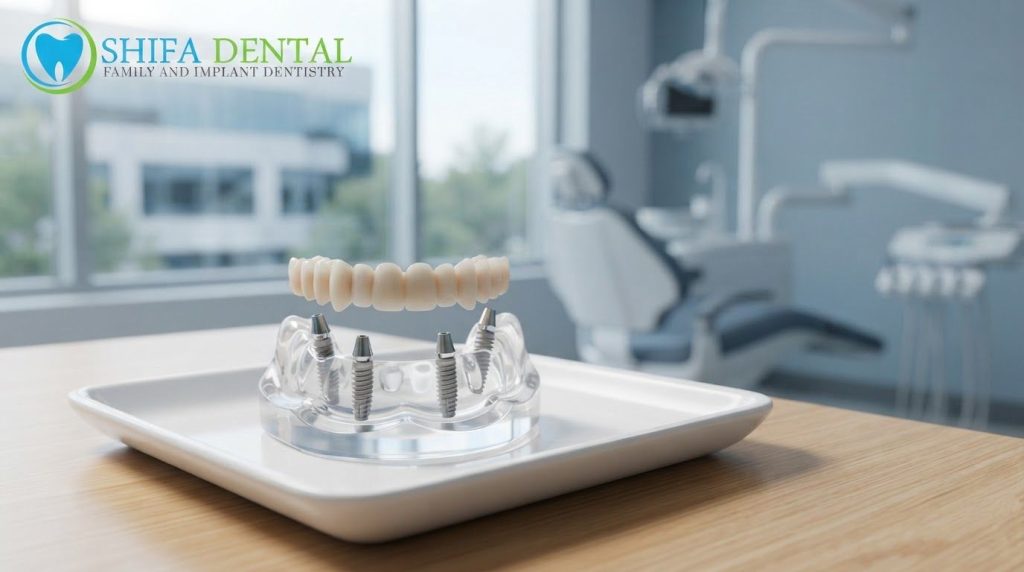
The all-on-4 concept is elegantly simple yet scientifically sophisticated. Instead of placing a separate implant for each missing tooth (which would require 14–16 implants for a full mouth), this technique uses just four implants per arch—typically two in the front and two in the back, positioned at strategic angles. These four implants then support a custom-designed, permanently fixed bridge of prosthetic teeth that spans the entire arch. The result is a restoration that looks, feels, and functions like natural teeth.
Developed and refined over decades of clinical research, this approach has become the gold standard for full-mouth restoration. The American Academy of Implant Dentistry (AAID) recognizes all-on-4 dental implants as a highly successful treatment for edentulism (complete tooth loss). At Shifa Dental in Plano, TX, we’ve helped hundreds of North Dallas patients reclaim their smiles, confidence, and quality of life with this transformative procedure.
How Do All-on-4 Dental Implants Work Biologically?
Understanding how these implants function at the biological level helps explain why they’re so effective and long-lasting. The success of this procedure hinges on a process called osseointegration—the direct fusion of the titanium implant with the surrounding jawbone.
The Osseointegration Process: Bone and Implant Becoming One
When a titanium implant is surgically placed into the jawbone, your body doesn’t recognize it as a foreign object. Instead, the bone cells (osteoblasts) begin to grow directly onto the implant’s surface, creating a microscopic bond that becomes stronger over time. This process typically takes 3–6 months, depending on bone density and overall health. Unlike dentures, which rest on top of the gum and bone, all-on-4 implants become integrated into the jawbone itself, providing unparalleled stability and preventing the bone loss that naturally occurs when teeth are missing.
Why Four Implants Are Enough
The genius of this technique lies in implant positioning and biomechanics. The two posterior (back) implants are often angled at 45 degrees, maximizing contact with available bone and distributing chewing forces more evenly across the arch. This strategic angulation and the rigidity of the final bridge structure allow four implants to support a full arch of teeth. Research published in peer-reviewed journals shows that this approach distributes masticatory (chewing) forces more favorably than traditional single-tooth implants, reducing stress on individual implant sites.
The Prosthetic Component: Permanent or Removable?
The teeth attached to your implants are custom-fabricated from high-grade materials—typically acrylic resin or porcelain fused to a titanium framework. In most cases, these teeth are permanently fixed to the implant abutments, meaning you cannot remove them yourself. This is a key advantage: no adhesives, no slipping, and no need for daily removal and cleaning. However, your dentist can remove the entire prosthesis for maintenance or repair if needed.
All-on-4 Dental Implants vs. Other Full-Mouth Restoration Options
When facing complete tooth loss, Plano and North Dallas patients have several options. Let’s compare all-on-4 dental implants to traditional dentures and other implant-based solutions:
| Restoration Type | Initial Timeline | Permanence | Bone Preservation | Longevity |
|---|---|---|---|---|
| All-on-4 Implants | Temp teeth same day; final in 3–6 months | Permanently fixed (non-removable) | Excellent—implants stimulate bone | 15–25+ years (often lifetime) |
| Traditional Dentures | 4–8 weeks after tooth extraction | Removable daily | Poor—bone resorbs 25% in first year | 5–8 years (frequent adjustments needed) |
| Implant-Supported Dentures | 6–12 months (more implants needed) | Removable (clips to implants) | Better than dentures, not as good as all-on-4 | 10–15 years |
| All-on-6 Implants | Temp teeth same day; final in 3–6 months | Permanently fixed (non-removable) | Excellent—implants stimulate bone | 15–25+ years (often lifetime) |
Note: Longevity depends heavily on oral hygiene, regular dental visits, bone density, and lifestyle factors (smoking, diabetes, etc.).
Clinical Success Rates: What Does the Research Show?
One of the most reassuring aspects of this treatment is its proven track record. Multiple peer-reviewed studies have documented the long-term success of this approach.
According to research published in the Journal of Clinical Periodontology and the International Journal of Oral & Maxillofacial Implants, all-on-4 implants achieve success rates exceeding 95%. In fact, some long-term studies report success rates as high as 99.2% at 10 years and 94.8% at 15 years. A systematic review from the National Institutes of Health (NIH) found that the survival rate for these implants after 24 months exceeded 99.8%, with minimal biological or technical complications when proper surgical and prosthetic protocols are followed.
These numbers are significantly higher than traditional dentures, which show progressive bone loss and require frequent adjustments or replacement every 5–8 years. The American Academy of Implant Dentistry (AAID) confirms that implant failures occur in less than 5% of cases, and most failures are preventable through proper post-operative care and oral hygiene.
Why Do These Implants Succeed at Such High Rates?
Several factors contribute to the exceptional success of this restoration approach:
- Strategic Implant Positioning: By angling posterior implants, surgeons maximize bone contact and distribute forces evenly, reducing stress concentration.
- Immediate Stability: The fixed bridge design provides immediate rigidity, reducing implant micromotion during the critical early healing phase.
- Proven Surgical Protocols: Decades of refinement have optimized implant diameter, insertion torque, and depth for maximum osseointegration.
- Modern Materials: Titanium and its alloys are biocompatible and have been used successfully in orthopedic and dental applications for over 50 years.
The All-on-4 Procedure: What to Expect Step-by-Step
Understanding the all-on-4 treatment journey helps demystify the process and manage expectations. Here’s what your experience at Shifa Dental in Plano, TX will likely involve:
Phase 1: Comprehensive Consultation and Treatment Planning (Week 1–2)
Your journey begins with a detailed consultation. At Shifa Dental, we offer a free second-opinion consultation for all-on-4 candidates, ensuring you feel confident in your decision. During this visit, we’ll perform a thorough examination, take 3D CBCT (cone beam computed tomography) scans to assess bone density and volume, review your medical history, and discuss your aesthetic goals. We’ll explain the all-on-4 process in detail, address your concerns, and provide transparent pricing with no hidden fees.
If bone grafting is needed (common in patients with significant bone loss), this phase may extend the overall timeline by 3–6 months, as grafted bone must heal and integrate before implant placement.
Phase 2: Implant Placement Surgery (Day of Procedure)
On surgery day, you’ll receive sedation (typically IV sedation or local anesthesia with nitrous oxide) to keep you comfortable and relaxed. The surgeon will:
- Extract any remaining teeth (if not done previously).
- Prepare the jawbone to receive the implants, carefully positioning sites to maximize bone contact and avoid vital structures like the inferior alveolar nerve.
- Place four titanium implants at strategic angles—two in the front region and two in the posterior region at 45-degree angles.
- Attach temporary abutments and a temporary fixed bridge (usually acrylic resin) to the implants.
- Send you home with temporary teeth the same day.
The procedure typically takes 2–3 hours. You’ll wake up with a full arch of teeth—a transformative moment for many patients. Recovery is relatively quick; most patients return to light activities within a few days.
Phase 3: Osseointegration and Temporary Restoration (Months 1–6)
For the next 3–6 months, your jawbone will fuse with the implants through osseointegration. During this time, you’ll wear the temporary bridge, which allows you to eat, speak, and smile naturally while the implants heal. You’ll have follow-up appointments to monitor healing, make minor adjustments to your bite, and ensure comfort.
It’s critical during this phase to follow post-operative care instructions: avoid hard or sticky foods, maintain meticulous oral hygiene, and avoid smoking (which can compromise osseointegration).
Phase 4: Final Restoration (Month 4–6)
Once osseointegration is complete, your dentist will remove the temporary bridge and fabricate your permanent restoration. This is typically made from high-quality acrylic resin or porcelain fused to a titanium framework. The permanent all-on-4 restoration is custom-designed to match your facial anatomy, bite, and aesthetic preferences. You’ll have try-in appointments to ensure fit and bite before final delivery.
Phase 5: Long-Term Maintenance (Ongoing)
After your permanent all-on-4 restoration is delivered, ongoing care is straightforward: brush twice daily, floss or use an interdental cleaner, and visit your dentist every 6 months for professional cleaning and implant health checks. Unlike natural teeth, implants don’t decay, but the surrounding bone and gum tissues can develop disease (peri-implantitis) if neglected.
All-on-4 Dental Implants in Plano, TX: Cost, Insurance, and Financing Options
One of the most common questions we hear is: “How much do all-on-4 dental implants cost?” The answer varies based on individual factors, but Shifa Dental is committed to transparent pricing and affordability.
Typical Cost Ranges for All-on-4 Implants
In the North Dallas market (Plano, Garland, and surrounding areas), all-on-4 dental implants typically range from moderate to higher investment depending on materials, complexity, and whether bone grafting is needed. At Shifa Dental, we provide detailed cost estimates during your consultation, breaking down each component: implants, abutments, temporary restoration, final prosthesis, and any necessary bone grafting.
Our “No Hidden Fees” policy means all costs are quoted upfront, and you’ll never encounter surprise charges. This transparency is one reason North Dallas families trust Shifa Dental for major procedures.
What Does Insurance Cover?
Dental insurance coverage for all-on-4 implants varies widely. Some plans cover a portion of the implant surgery and abutments (often 50%), while others cover only the extraction and temporary restoration. The final prosthesis is frequently classified as a major restorative procedure and may be subject to annual maximums or waiting periods.
At Shifa Dental in Plano and Garland, we accept most major insurance plans, including children’s Medicaid and CHIP. We’ll verify your coverage and help you understand what your plan will pay before you commit to treatment.
Financing and Payment Plans
If you don’t have insurance or your coverage is limited, Shifa Dental offers multiple affordability solutions:
- 0% Interest Financing: Spread your treatment cost over 12–24 months with no interest charges.
- CareCredit: A healthcare-specific credit card that offers promotional financing periods.
- Shifa Dental Saving Plan: Our in-house membership plan for uninsured patients, offering discounts on all procedures including implants.
- Flexible Payment Plans: We work with you to create a payment schedule that fits your budget.
Many patients are surprised to learn that when you factor in the longevity of all-on-4 implants (15–25+ years versus 5–8 years for dentures), the long-term cost per year is often comparable to traditional dentures—but with superior comfort, function, and bone preservation.
Ideal Candidates for All-on-4 Dental Implants in Plano, TX
Are you a good candidate for all-on-4 dental implants? Here are the key criteria:
Eligibility Factors
- Missing Most or All Teeth: All-on-4 is designed for patients with complete or near-complete tooth loss in one or both arches.
- Adequate Bone Density: Your jawbone must have sufficient height and width to support implants. If bone is deficient, grafting can often restore it.
- Good Overall Health: Conditions like diabetes, heart disease, or autoimmune disorders don’t automatically disqualify you, but they require careful management and monitoring.
- Commitment to Oral Hygiene: All-on-4 success depends on your willingness to maintain excellent home care and regular dental visits.
- Realistic Expectations: Understanding that all-on-4 implants are a major investment requiring time and commitment.
Relative Contraindications
Certain factors may complicate all-on-4 treatment but don’t necessarily exclude you:
- Smoking: Smoking increases implant failure risk by up to 20%. We strongly encourage smoking cessation before and after surgery.
- Uncontrolled Diabetes: High blood sugar impairs bone healing. Patients with controlled diabetes typically do well with implants.
- Severe Bone Loss: Extensive bone resorption may require bone grafting, extending the timeline but not preventing all-on-4 treatment.
- Certain Medications: Bisphosphonates (used for osteoporosis) require special consideration. Discuss all medications with your dentist.
At Shifa Dental, we perform a comprehensive evaluation to determine your candidacy and discuss options tailored to your situation. A free second-opinion consultation can answer all your questions.
Recovery and Aftercare: What Happens After Your All-on-4 Surgery
Understanding post-operative expectations helps ensure smooth healing and optimal results.
Immediate Post-Operative Period (Days 1–7)
Immediately after all-on-4 implant surgery, you can expect:
- Swelling: Peak swelling typically occurs 48–72 hours after surgery. Ice application during the first 24 hours helps minimize this.
- Discomfort: Mild to moderate discomfort is normal and managed with prescribed pain medication. Most patients report discomfort is less than expected.
- Bleeding: Minor oozing is normal. Use gauze as directed and avoid rinsing or spitting forcefully for the first few days.
- Diet: Stick to soft foods, smoothies, soup, and cool beverages for the first week. Avoid hard, hot, or sticky foods.
- Activity: Rest for the first 3–5 days. Avoid strenuous exercise, heavy lifting, and bending over.
Weeks 2–6: Progressive Healing
By week two, most swelling and discomfort subside. You can gradually return to normal activities and soft foods. Your temporary bridge allows you to eat, speak, and smile naturally. Continue meticulous oral hygiene, but avoid disturbing the surgical sites. Attend all follow-up appointments so your dentist can monitor healing and make any necessary adjustments.
Months 2–6: Osseointegration Phase
During this critical phase, your jawbone is fusing with the implants. You may feel occasional twinges or pressure sensations—this is normal. Continue excellent oral hygiene, avoid smoking, and follow dietary recommendations. Some patients report improved comfort and stability as osseointegration progresses.
Long-Term Care (After Permanent Restoration)
Once your permanent all-on-4 restoration is placed, maintenance is straightforward:
- Daily Brushing and Flossing: Brush your teeth twice daily and floss or use an interdental cleaner daily, just as you would with natural teeth.
- Avoid Damaging Habits: Don’t chew on hard objects (ice, hard candy, pens), which can crack the prosthesis.
- Professional Cleanings: Visit Shifa Dental every 6 months for professional cleaning and implant health assessment.
- Smoking Cessation: If you smoke, quitting significantly improves long-term implant success.
- Regular Exams: Your dentist will monitor bone levels, implant stability, and the integrity of the prosthesis.
Potential Complications and How to Avoid Them
While all-on-4 dental implants have exceptional success rates, it’s important to understand potential complications and how to prevent them.
Peri-Implantitis (Implant Gum Disease)
The most common long-term complication is peri-implantitis—inflammation or infection of the tissues surrounding the implant. This occurs when plaque and bacteria accumulate around the implant, similar to gum disease around natural teeth. Prevention is simple: maintain excellent oral hygiene, floss daily, and visit your dentist every 6 months. Early detection and treatment (professional cleaning, antimicrobial therapy, or in severe cases, implant removal) can prevent bone loss.
Implant Failure or Loss of Osseointegration
In rare cases (less than 5%), an implant may fail to integrate or may be lost after integration. Risk factors include smoking, uncontrolled diabetes, poor oral hygiene, and excessive loading before osseointegration is complete. At Shifa Dental, we minimize this risk through careful patient selection, precise surgical technique, and clear post-operative instructions.
Bite Problems or Prosthetic Issues
Occasionally, the permanent bridge may require bite adjustment or minor repairs. This is normal and easily corrected during follow-up appointments. The design of all-on-4 restorations allows for adjustment and repair without replacing the entire prosthesis.
Nerve Damage
During implant placement, there’s a small risk of temporary or permanent nerve injury, resulting in numbness or tingling in the lower lip, chin, or tongue. This is rare when surgery is performed by an experienced, well-trained dentist using precise 3D imaging and careful surgical technique.
All-on-4 Dental Implants vs. All-on-6: Which Is Right for You?
You may have heard of “All-on-6” as an alternative to all-on-4. How do they compare?
All-on-6 implants use six implants instead of four, providing additional support and potentially better load distribution. This approach may be recommended for patients with significant bone loss, heavy bite forces, or those who want maximum redundancy. However, all-on-6 requires more implants, more surgery, and higher cost. Research shows that all-on-4 and all-on-6 have similar long-term success rates when properly selected and executed. For most patients, all-on-4 offers an excellent balance of efficacy, cost, and surgical invasiveness.
At Shifa Dental, we’ll evaluate your bone density, bite force, and aesthetic goals to recommend whether all-on-4 or all-on-6 is the better choice for you. This personalized approach ensures you get the best outcome at the best value.
Why Choose Shifa Dental in Plano, TX for Your All-on-4 Implants?
Selecting the right dental practice for such a significant procedure is crucial. Here’s why North Dallas families choose Shifa Dental:
- Free Second-Opinion Consultations: We offer complimentary second opinions for all-on-4 and other major procedures, ensuring you feel confident in your decision.
- No Hidden Fees: All costs are quoted upfront. You’ll never encounter surprise charges.
- Flexible Financing: 0% interest financing, CareCredit, and our Shifa Dental Saving Plan make treatment accessible.
- Multilingual Staff: Our team speaks English, Urdu, Punjabi, Telugu, Kannada, and Spanish, ensuring clear communication.
- Saturday and Emergency Appointments: We offer Saturday hours and same-day emergency appointments because we know life doesn’t follow a 9-to-5 schedule.
- Insurance Flexibility: We accept most major insurance plans, including children’s Medicaid and CHIP.
- Two Convenient Locations: Serving Plano, Garland, Allen, Frisco, McKinney, and Richardson with offices at:
Plano Office: 5509 Pleasant Valley Dr #90A, Plano, TX 75023 | (469) 507-3786
Frequently Asked Questions About All-on-4 Dental Implants in Plano, TX
How long do all-on-4 dental implants last?
With proper care—daily brushing, flossing, regular dental visits, and avoiding smoking—all-on-4 implants can last 15–25 years or even a lifetime. The implants themselves often outlast the prosthetic teeth, which may need replacement after 15–20 years. This is still far superior to traditional dentures, which typically last only 5–8 years.
Can you get all-on-4 implants if you have bone loss?
Yes. If you have significant bone loss, your dentist may recommend bone grafting before implant placement. Bone grafts typically heal within 3–6 months, after which implant surgery can proceed. At Shifa Dental, we evaluate bone density with 3D imaging and discuss grafting options during your consultation.
Are all-on-4 implants painful?
The procedure itself is not painful because you receive sedation and local anesthesia. Post-operative discomfort is typically mild to moderate and managed with prescribed pain medication. Most patients report that discomfort is less than they anticipated. You can return to light activities within a few days.
How much do all-on-4 dental implants cost in Plano, TX?
Costs vary based on individual factors like bone density, need for grafting, and material choices. At Shifa Dental, we provide transparent pricing during your consultation. We offer 0% financing, CareCredit, and our Shifa Dental Saving Plan to make treatment affordable. Many insurance plans cover a portion of the cost.
Can you remove all-on-4 implants if needed?
Yes, though it’s rare. Your dentist can remove the prosthesis for maintenance or repair. In the unlikely event of severe implant failure, implants can be surgically removed, though this is not typical. The goal is to maintain your all-on-4 restoration for decades.
What’s the difference between all-on-4 and traditional dentures?
All-on-4 implants are permanently fixed, prevent bone loss, and last 15–25+ years. Traditional dentures are removable, cause progressive bone loss, and typically last 5–8 years. All-on-4 implants offer superior comfort, function, and longevity, though they require a higher upfront investment. Many patients find the long-term value of all-on-4 far exceeds the cost.
Conclusion: Reclaim Your Smile with All-on-4 Dental Implants in Plano, TX
Complete tooth loss can profoundly impact your confidence, health, and quality of life. Fortunately, all-on-4 dental implants offer a transformative solution that restores not just your teeth, but your smile, your ability to eat and speak naturally, and your self-esteem.
With clinical success rates exceeding 95%, the ability to receive temporary teeth the same day of surgery, and the potential for a lifetime of function with proper care, all-on-4 implants represent one of modern dentistry’s greatest achievements. At Shifa Dental in Plano, TX, we’ve helped hundreds of North Dallas patients reclaim their smiles through this life-changing procedure.
If you’ve been living with missing teeth, struggling with uncomfortable dentures, or wondering whether you’re a candidate for all-on-4 implants, we invite you to schedule a free second-opinion consultation. Our experienced team will evaluate your unique situation, answer all your questions, and discuss transparent pricing and flexible financing options.